
Leadership: The Balance Between Individual Effectiveness and Organizational Dynamics

Seit über 25 Jahren begleitet er als Berater, Coach und Sparringspartner Führungskräfte, Teams und Organisationen in Veränderungsprozessen. Zudem lehrt er Organisationsentwicklung und Führung an den Universitäten Bielefeld und Paderborn.
02# Value Insider
In times of major change, crises and challenges, the topic of leadership takes centre stage even more. Leadership is then often seen as a rather superficial panacea for all problems, without really getting to the heart of the matter.
However, anyone who wishes to understand leadership must consider it from at least two perspectives. On the one hand, at the organisational level, which concerns structures, decision-making processes, patterns of interaction and the organisation of collaboration. On the other hand, at the individual level, which concerns the behaviour of individual leaders, their impact, their communication and their personal presence. Both levels are inextricably linked, and yet in practice they are often treated as separate
The key question, therefore, is how organisations should be structured today and what impact leadership has in this context. Against a backdrop of increasing complexity and constant change, the dual perspective outlined here is becoming increasingly important. Organisations need structures that enable adaptability and leaders who provide direction. Future-proof leadership arises precisely from the interplay of these two dimensions.
A look at the individual level shows that leadership has an impact that extends far beyond formal decisions or processes. The personal influence of leaders has a significant impact. How clearly they communicate values and objectives, how credible they appear, and how emotionally responsive they are often shapes motivation, trust and commitment more strongly than formal guidelines or strategy documents.
One factor that has long been underestimated in this context is charisma. In everyday life, charisma is often seen as an innate trait of certain individuals. Some people seem to possess it, whilst others do not. Leadership research, however, paints a much more nuanced picture. Charismatic leadership describes not so much a personality trait as a specific form of communication. Leaders come across as charismatic when they are able to convey values, purpose and direction
This also shifts the perspective on the effectiveness of individual leadership. It is no longer enough to be professionally competent or to make decisions efficiently. Leadership is increasingly becoming a communicative task. As well as strategies and processes, people also follow charismatic leaders. They are guided by whether leaders can plausibly explain why change is necessary and what significance collective action has.
Empirical studies show that charisma consists of two components. One part is person-specific, such as charisma, extraversion or perceived competence. These aspects can only be influenced to a very limited extent. However, there is also a second, often underestimated component: skills that can be learnt. Rhetorical techniques, storytelling, symbolic communication and a clear articulation of values can all be practised.
This is precisely where the practical potential of charismatic leadership lies. Research shows that targeted charisma training produces measurable results. Managers who learn to speak in an inspiring way and convey goals in an emotionally engaging manner are perceived as significantly more charismatic. At the same time, staff levels of motivation, trust and willingness to perform increase.
One reason for this lies in the creation of meaning and the sense of direction provided. People respond to meaningful contexts. It is precisely in situations of uncertainty that the need for context and direction arises. Charismatic communication enhances the perceived meaning of a task whilst simultaneously strengthening confidence in one’s own effectiveness. This makes leadership emotionally engaging.
It is interesting to note that charisma is not necessarily linked to volume or dominance. It is often the case that quiet leaders make a strong impression when their communication is consistent, credible and clear. Coherence is more important than putting on a show. People observe very closely whether communication and behaviour are consistent. Where this connection is lacking, even powerful rhetoric quickly loses its impact.
As important as the personal influence of leaders is, their limitations are equally evident. Charisma alone cannot solve structural problems. A critical pattern emerges in many organisations: complexity is individualised. Instead of scrutinising patterns of interaction, decision-making processes and structures, attention is focused on individual leaders. They are expected to provide guidance, motivate, resolve conflicts, explain complexity and, at the same time, take responsibility for results
This expectation inevitably leads to people being overwhelmed. Complex challenges cannot be tackled individually, but only collectively. This is precisely where the alternative perspective on leadership begins. The focus is not on the individual, but on the question of how organisations foster decision-making capacity.
In practice, a contradiction often becomes apparent. On the one hand, organisations are expected to become more agile, innovative and adaptable. On the other hand, decision-making structures remain highly centralised. Responsibility is distributed in theory, but in practice is often pulled back up the hierarchy. This leads to delays, uncertainty and friction. This is the paralysing reality of everyday life for many organisations undergoing change processes.
The result is a structural dilemma: leaders are held responsible for both stability and change. They are expected to instil a sense of security whilst at the same time driving transformation. However, these conflicting expectations cannot be resolved at an individual level. It is at this point, if not before, that it becomes clear why the question of future-proof leadership must not be understood merely as a matter of personal competencies.
The operating environment in which organisations operate is constantly changing, with the result that constant adaptation has gone from being the exception to the norm. Markets are changing more rapidly, technological developments are having a profound impact on business models, and decisions must be taken under conditions of high uncertainty.
This trend is particularly evident in the use of artificial intelligence (AI). AI is not only transforming processes, but increasingly the very logic of value creation itself. Information becomes available more quickly, analyses are more precise, and the basis for decision-making is more comprehensive. At the same time, however, the quality of decisions does not automatically improve. On the contrary: the more information there is, the more important it becomes to identify what is relevant and to provide guidance.
In this context, traditional management approaches are reaching their limits. Planning, control and linear implementation degenerate into the classic ‘business theatre’ of hollow platitudes. It is at this point, if not before, that it becomes clear that complexity cannot be simplified or reduced. It does not simply disappear through rationalisation, but often merely shifts to other areas, thereby becoming harder to identify and even less controllable.
Many organisations continue to respond to uncertainty with detailed planning. Change is organised as a project, with clear objectives, milestones and defined end points. This approach conveys a sense of security, but rarely works. In complex environments, developments can often only be understood in hindsight. Those who attempt to gain control through detailed planning in such situations often achieve the opposite: increasing friction and decreasing adaptability.
The implication of this is uncomfortable, but clear. Transformation is no longer an exceptional circumstance, but rather part of value creation. It does not proceed in a linear fashion, but rather iteratively. Leadership is therefore faced with the task of ensuring the system’s ability to make decisions, even when no clear answers are available.
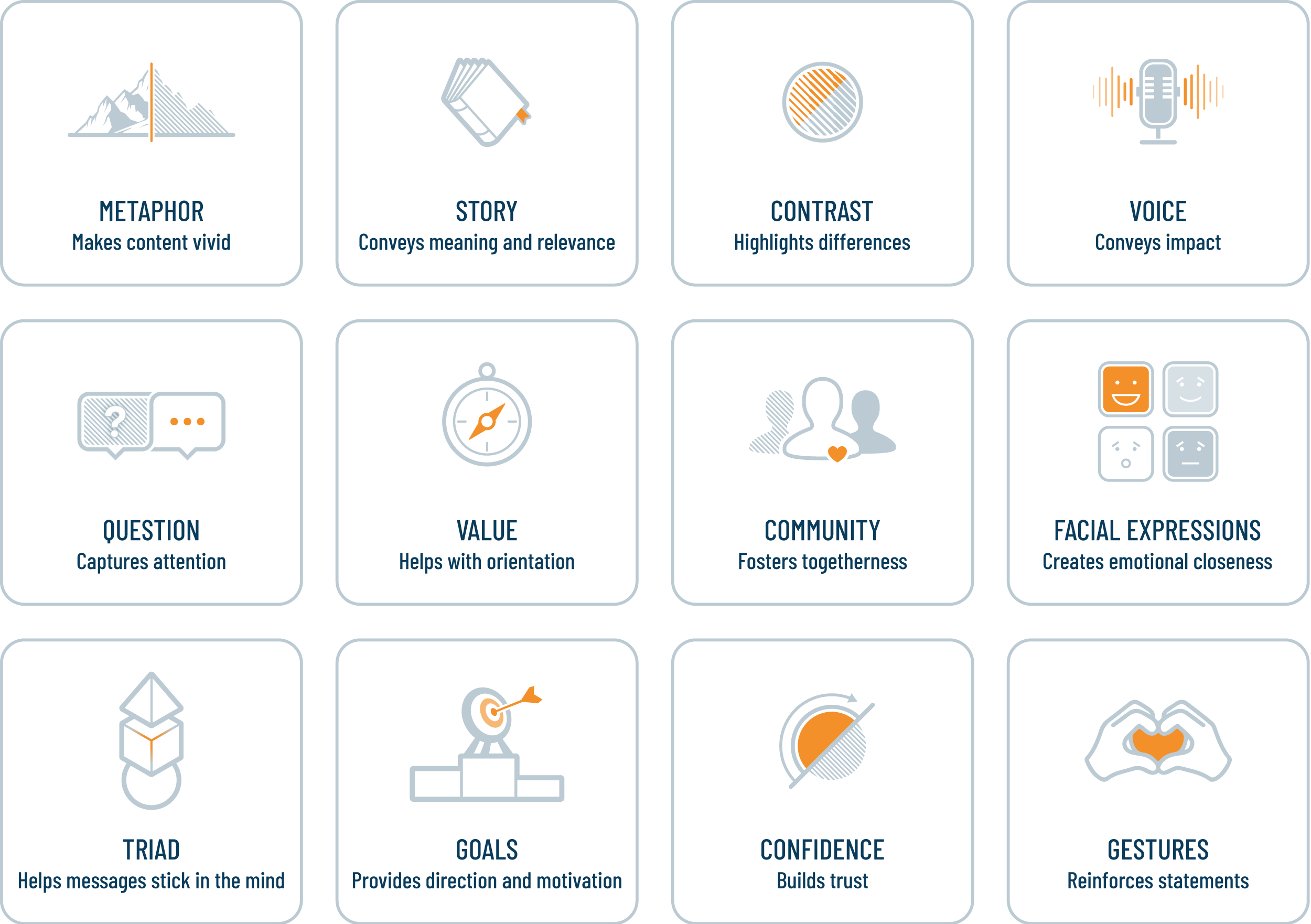
Verbal techniques such as metaphors, stories and contrasts, as well as non-verbal cues such as tone of voice, facial expressions and gestures, make messages easier to understand, more emotive and more memorable. They demonstrate that charisma does not stem solely from personality, but can be deliberately enhanced through conscious communication.
It is precisely during transformation processes that it becomes particularly clear just how closely individual impact and organisational structures are intertwined. Many change initiatives fail not because of a lack of strategies or inadequate measures, but also because people do not feel a genuine connection to the change. The management of many companies often underestimates the fact that change is not processed solely on a rational basis. It creates uncertainty, a loss of control and often
That is why it is not enough to explain transformation purely in technical or procedural terms. Leadership must make change emotionally relatable. People want to understand why changes are necessary, what contribution they themselves can make, and what they should use as a guide during periods of high uncertainty. This is precisely where the importance of effective communication becomes apparent once again. Leaders do not build trust by promising complete certainty, but by
And then there is corporate culture – the sum total of all the formal and informal rules governing day-to-day life – which does not arise from mission statements or communication campaigns, but rather from recurring patterns of interaction in everyday life that become established and prove useful to the organisation. Employees observe very closely which decisions are actually made, how mistakes are dealt with, and whether responsibility is genuinely shared or merely rhetorical
Sustainable leadership therefore also means ensuring consistency. Organisations need leaders who not only communicate change, but also demonstrate it through their own behaviour. Particularly in complex environments, credibility stems less from perfection than from clarity, the ability to learn and a reflective approach to uncertainty. Leadership is thus increasingly becoming a matter of fostering social connectivity, both at an individual and an organisational level.
A common reflex in management is the desire to reduce complexity. Processes are standardised, structures streamlined and decision-making centralised. The associated hope – which is widespread, though often surprisingly naïve – is that this will lead to greater transparency and better control within organisations.
However, real-world experience starkly illustrates that this approach is overly simplistic. Complexity does not disappear; it merely changes its form. What initially appears to be a simplification often gives rise to new interdependencies and uncertainties. As a result, organisations generally become neither more resilient nor faster, but rather more fragile.
At the same time, complexity is fundamentally changing the demands placed on leadership. In the past, leadership was often seen as the ability to provide clear-cut answers. Today, leadership increasingly stems from the ability to deal with ambiguity. It is not certainty that is becoming the key resource, but the ability to remain capable of taking action despite uncertainty.
This also shifts our understanding of decision-making. More than ever before, decisions are seen less as definitive solutions and more as temporary commitments subject to change. Organisations must learn to learn more quickly, rather than plan more precisely.
The importance of retrospectives and organisational learning is particularly underestimated in this context. Many companies invest considerable resources in projects and transformations, yet fail to systematically evaluate what actually worked and what did not. As a result, mistakes are repeated and lessons learnt are lost. In complex environments, speed is not primarily achieved through better planning, but through faster learning. And to dispel a myth: Niema
As complexity increases, conflicting demands no longer arise one after the other, but simultaneously. Organisations must be stable yet capable of change, efficient yet innovative, clearly focused yet adaptable.
These tensions are not temporary phenomena, but a reflection of organisational reality. Forward-looking leadership therefore does not seek to resolve contradictions entirely. Rather, it seeks to keep them productive.
Paradox management thus becomes a core competence of modern leadership. Decisions are no longer seen as one-off determinations, but as a balancing act between conflicting demands. In this context, leadership means enduring tensions without losing one’s bearings.
This also changes the psychological dimension of leadership. For years, many leaders have been conditioned to create a sense of security through control. In complex environments, however, this approach is becoming increasingly ineffective. Control is becoming more limited, whilst at the same time the pressure to provide quick and clear answers is mounting.
It is precisely here that the true sustainability of leadership is determined. It is not the illusion of complete control that builds trust, but the ability to be transparent about uncertainty whilst still remaining capable of taking action.
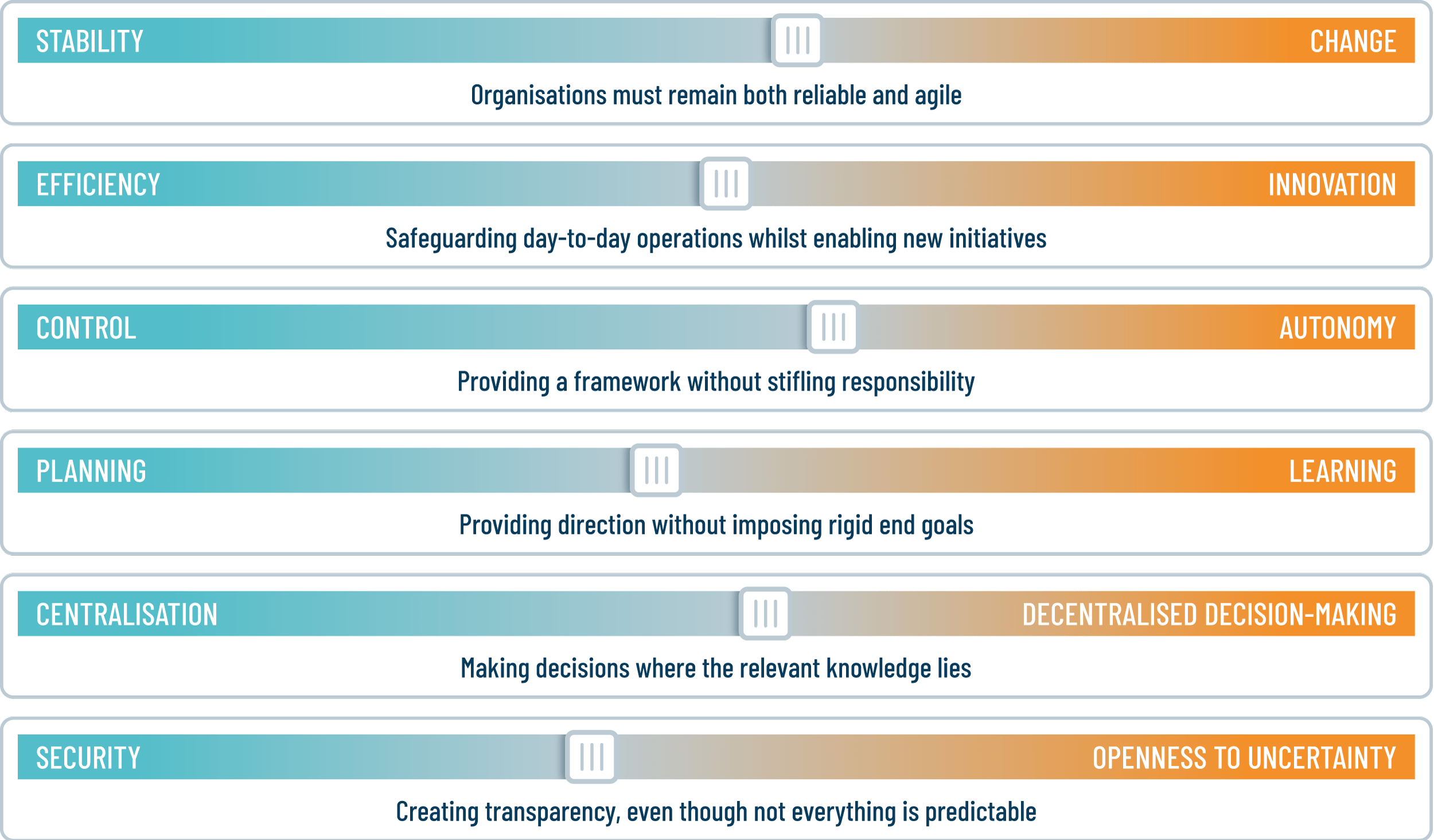
Modern leadership navigates between conflicting demands such as stability and change, control and autonomy, or security and openness. The key is to manage these tensions productively.
At the same time, the very concept of leadership is changing. In complex environments, decisions can no longer be taken centrally without compromising on quality or speed. There is a growing realisation that leadership is a process that takes place simultaneously in many different areas. Responsibility is shared, and decisions are made where the relevant knowledge is available.
This also changes the role of managers. Technical expertise remains important, but is no longer enough. What becomes crucial is the ability to provide guidance, build trust and foster psychological safety.
Vertrauen wird dabei zu einer zentralen Voraussetzung kollektiver Handlungsfähigkeit. Ohne psychologische Sicherheit übernehmen Menschen keine Verantwortung. Sie vermeiden Risiken, sichern sich ab und orientieren sich an formalen Zuständigkeiten statt an Problemlösungen. Organisationen verlieren dadurch Geschwindigkeit und Anpassungsfähigkeit.
Leadership therefore increasingly means creating spaces in which people can take on responsibility. This requires that mistakes are not merely punished, but are also seen as a source of learning. Particularly in complex environments, innovation rarely arises without friction or uncertainty.
This brings us full circle to the individual impact of leadership. Charisma and clear communication are becoming increasingly important precisely because they can support collective capacity for action. They provide guidance in situations where traditional control mechanisms reach their limits.
There is no single-dimensional answer to the question of what kind of leadership organisations need for the future. It requires a conscious integration of individual impact and organisational patterns of interaction.
Charismatic communication can strengthen direction, purpose and motivation. It can foster trust and increase a willingness to embrace change. At the same time, it is no substitute for structural work on decision-making processes, learning processes and the allocation of responsibilities.
Future-proof leadership operates precisely within this area of tension. It harnesses the personal influence of leaders without overburdening them, and structures organisations in such a way that leadership is not tied to individuals but becomes effective within the system.
In the past, the focus was often on making the ‘right’ decision. Today, it is becoming increasingly clear that what really matters is remaining capable of making decisions at all – even when there is no clear-cut solution. This is precisely where the real challenge of modern leadership lies.
You are currently viewing a placeholder content from Hubspot Embedded Content. To access the actual content, click the button below. Please note that doing so will share data with third-party providers.
More InformationYou are currently viewing a placeholder content from HubSpot. To access the actual content, click the button below. Please note that doing so will share data with third-party providers.
More InformationYou are currently viewing a placeholder content from Hubspot Meetings. To access the actual content, click the button below. Please note that doing so will share data with third-party providers.
More Information