
2026: The end of the linear concept of time
02# Value Insider
Companies are no longer faced with the question of whether they need to change. It is clear that change is necessary. The crucial question is rather: how can it be achieved when an ever-increasing number of priorities are placing demands on the organisation at the same time? Boosting efficiency, securing growth, cutting costs, making sustainability measurable, integrating AI, stabilising supply chains, retaining talent and developing new business models. All of these are on the agenda today, simultaneously.
This presents a new challenge for board members and those responsible for transformation: many organisations have already launched countless programmes, projects and key performance indicators. However, rather than forming a powerful whole, this often results in a mass of initiatives that is difficult to manage. The key task is to orchestrate these activities in such a way that they deliver demonstrable results.
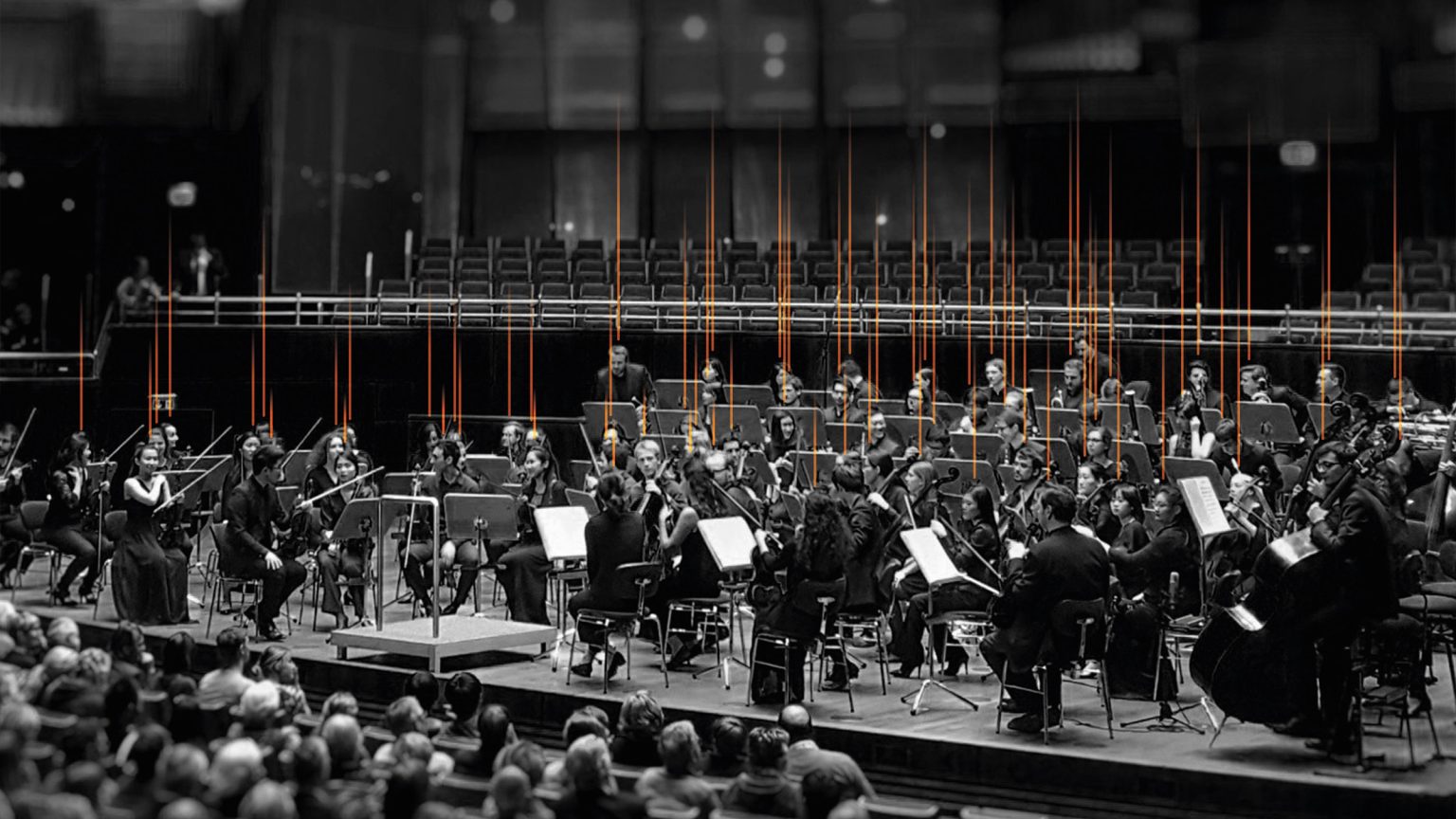
Before them lies a whole orchestra of initiatives, projects and key performance indicators. Yet all too often, instead of a clear symphony, what emerges is a cacophony. It is precisely here that the future of an organisation is decided. An orchestra is effective when different instruments and voices come together to create a unified sound. A conductor does not have to be the best violinist. Their task is to coordinate the entries, set a common tempo and identify dissonances at an early stage.
This is where the parallel with modern corporate management lies. Companies, too, have strong individual voices: bold AI initiatives, rigorous efficiency programmes, ambitious sustainability targets and ambitious key performance indicators. However, they only realise their full potential when they work in a coordinated manner towards shared goals.
Without this guiding hand, organisational fragmentation ensues. Programmes run in parallel, data tells conflicting stories, and priorities are lost sight of. Strategic deviations often only become apparent once they have already cost a great deal of time and money. The organisation is in flux, but lacks a shared direction.
Orchestrating transformation therefore means linking leadership, objectives, people, data and implementation in such a way that progress becomes visible, decisions are clear and results are robust. Business impact arises from the targeted interplay of these elements.
The notion of transformation as a temporary, exceptional situation is now outdated. Achieving a clearly defined target state and then returning to a stable, normal state: this understanding is becoming increasingly at odds with the reality of today’s markets.
Transformation has evolved from an exceptional circumstance to an integral part of day-to-day operations. At a time of multiple concurrent crises, the conditions shaping the global economy are changing rapidly. Geopolitical shifts and fragile supply chains are increasing business risks. Technological developments such as generative AI are shortening planning cycles. At the same time, macroeconomic and regulatory pressures – particularly in the context of ESG – are placing greater demands on precise management.
In this context, leadership goes far beyond simply improving efficiency in the traditional sense. It must provide direction, build trust and keep the organisation moving forward despite conflicting demands, without resorting to knee-jerk reactions.
This also changes our understanding of performance. Financial KPIs and cost discipline remain key pillars. At the same time, strategic adaptability, innovative strength, measurable sustainability and customer focus are becoming increasingly important.
It is precisely this lack of synchronisation that makes orchestration necessary. When departments work in isolation to optimise their own objectives, key performance indicators reflect different realities, and parallel initiatives follow different lines of reasoning, the result is a great deal of organisational friction but little collective impact.
This therefore raises a key question for company management: How can this simultaneity be managed without the organisation becoming paralysed by its own complexity?
Strategies often fail when they come up against day-to-day operational realities.
Many large-scale transformations begin with a high level of intensity, a clear vision and significant attention from management. However, the real stress test begins when strategic ambitions come up against the realities of day-to-day operations: scarce resources, budget silos that have developed over time, competing priorities and time-sensitive operational decisions.
Middle management, in particular, finds itself caught between strategic ambitions and operational pressures. This is precisely where the gradual erosion of a strategy begins. In the competition for resources and attention, one milestone is postponed, whilst elsewhere a deviation from standard procedure is permitted. Critical decisions are put off, and responsibilities are passed on.
Taken individually, each of these decisions appears pragmatic in the short term and is often understandable. Taken together, however, they gradually steer the organisation away from its strategic objectives.
Initial consistency gives way to compromise. Strategic priorities become negotiable, and in the end it is often the loudest voice that attracts the most attention.
Anyone who continues to view transformation as a linear journey from A to B underestimates the dynamics of modern markets. Effective change occurs in cycles: calibrate, implement, reflect and readjust. This also involves consciously building up new energy for the next phase.
Frauke von Polier explains why a modern view of human nature and contextual leadership form the basis of a resilient culture of implementation.
Prof. Dr. Ronald Gleich highlights the methodological aspect and explains why, in volatile times, business impact requires clear direction, focus and consistency.
Effectiveness requires context, trust and the drive to implement. Strategies only become effective when people understand them, adapt them to their own working context and embed them in their day-to-day work.
The workforce is therefore not merely a peripheral factor in performance, but one of its most important drivers. A top-down mobilisation at the kick-off is not enough to achieve this. True leadership lies in sustaining energy and a willingness to change over the long term.
This also involves factoring in operational friction, cultural resistance and change fatigue as part of the process. These are not unexpected disruptions, but factors that leadership must deal with.

Frauke von Polier ist Mitglied des Board of Directors der Viessmann Generations Group und verantwortet seit April 2026 die unternehmensweite AI-Transformation sowie die Verankerung zukunftsorientierter Führungsmodelle.
Prof. Dr. Ronald Gleich ist Professor für Managementpraxis und Controlling an der Frankfurt School of Finance & Management und Academic Director des Centre for Performance Management & Controlling.
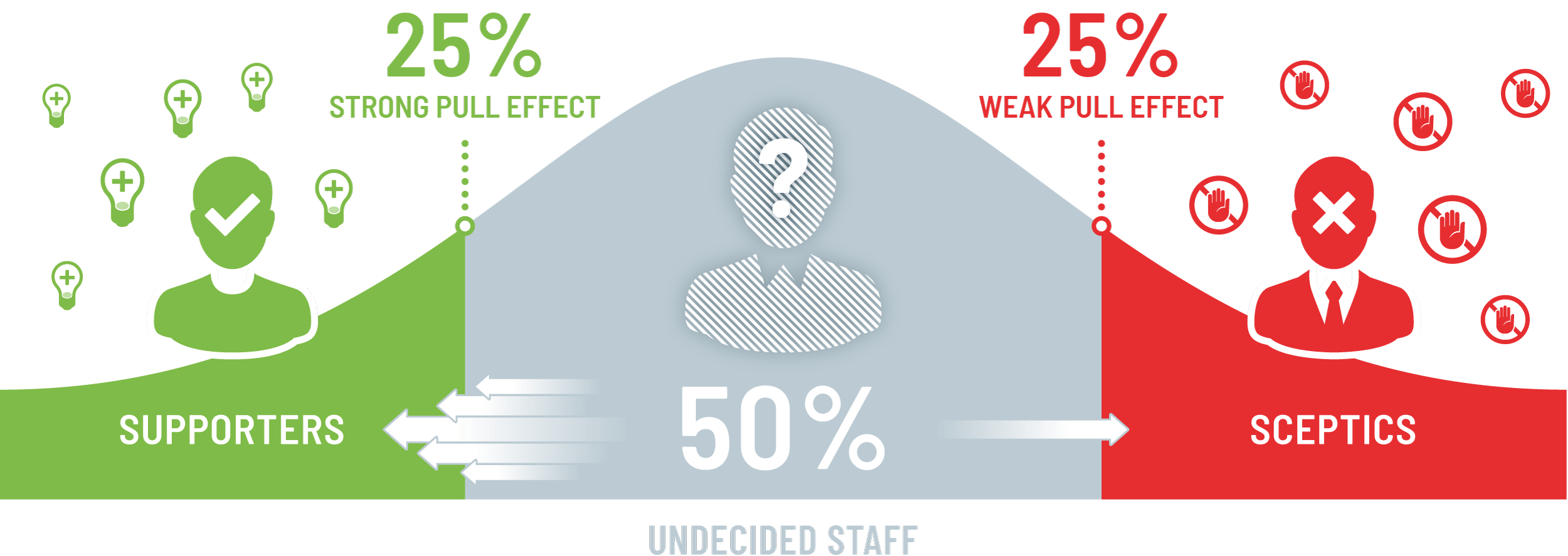
A classic mistake made by many transformation programmes is to focus a great deal of attention on the sceptics. In doing so, management ties up its time and emotional resources on precisely the group that generates the least momentum.
Frauke von Polier therefore deliberately chooses a different angle: ‘And what about those who are willing?’ This shift in perspective moves the focus away from managing resistance and towards specifically strengthening the drive to shape the future. ‘We design everything for those who are willing, not for those who aren’t. That is the real lever.’
The implication is this: anyone who identifies intrinsically motivated staff, involves them as credible experts within their field, and provides them with genuine responsibilities and budgets can generate momentum within the organisation.
This ‘coalition of the willing’ works closely with the specific problems faced by customers and processes. Data from McKinsey supports this view: according to the analysis, companies that involve 21 to 30 per cent of their workforce in key transformation roles achieve the highest total shareholder returns.
Active participation thus becomes a key performance indicator.
Information alone does not provide strategic direction. Particularly in times of information overload, more information can actually lead to further uncertainty. Von Polier sums up this idea as follows: ‘It is not really a right to information – that is a misunderstanding of transparency – but rather a right to context.’
Managers must therefore make clear the underlying circumstances, conflicting objectives and areas of tension behind their decisions. Only in this way can the organisation remain capable of acting effectively even in a decentralised structure. Those who understand the context can make decisions in the best interests of the organisation as a whole, without having to wait for a decision from the board every time there is a deviation.
This applies in particular to KPI management. If the organisation understands how a key performance indicator contributes to its strategic objectives, it becomes a navigational tool. If this link is missing, reporting can foster pressure to justify decisions, political debates and a culture of risk aversion.
Transparency is built on trust. It is fostered by the credibility and reliability of management’s actions, but also by respect for an organisation’s history.
Anyone who wants to change existing structures should understand and acknowledge why they came about.
Von Polier puts it pragmatically: ‘Nobody was stupid three years ago when that decision was made. It was the right decision at the time. But it’s having negative consequences today, which is why we need to change it.’
Culture and effective leadership are essential. However, to achieve measurable business impact, a management framework is also required that makes progress visible, identifies deviations at an early stage and enables targeted decisions.
Prof. Dr Ronald Gleich therefore views modern performance management as being significantly more comprehensive than traditional reporting. Reporting looks back. It documents what has happened and where the organisation currently stands. Performance management looks ahead. It uses this information to make decisions and influence future developments.
Nevertheless, regular board meetings and steering committee meetings are often dominated by a review of past performance. Red flags are highlighted, deviations explained and budgets defended. This provides transparency regarding the current situation, but does not automatically lead to better or faster decisions.
Effective management begins where data triggers action. Deviations from the plan are then not seen as a question of blame, but as a starting point for a necessary course correction.
The question is: ‘What decision do we need to make now?’ And not: ‘Who is to blame?’
Gleich sums up this approach as follows: ‘Measure less, manage more clearly and act more consistently.’
Having more dashboards and more key performance indicators does not automatically lead to better management. What matters is whether a key performance indicator enables specific decisions to be made. Does it highlight where resources are lacking? Does it reveal where investment is needed? And does it provide clarity on where action needs to be taken?
For forward-looking management, performance metrics – known as lagging indicators – must be linked to the underlying performance drivers, the leading indicators. Key performance indicators such as return on sales, EBITDA or market share primarily show what has already happened. By contrast, key performance indicators such as pipeline quality, pace of innovation, time-to-market or customer acquisition costs provide insights into future developments.
Anyone who manages a business solely on the basis of historical performance indicators is looking in the rear-view mirror. This increases the risk of missing the right moment to change course. In long-term studies, McKinsey has concluded that a consistent, forward-looking and data-driven approach to transformation can increase the success rate from an average of 26 per cent to 58 per cent.
For particularly volatile markets, Gleich describes the Reproflex model. It is based on three key capabilities:
Resilience
The ability to absorb external macroeconomic shocks. This includes financial stability and liquidity, as well as diversified value chains, proactive risk management and the reduction of critical dependencies within the supply chain.
Flexibility
The ability to adapt decisions and structures quickly. This includes flatter hierarchies, proximity to customers, short feedback loops and an IT architecture that supports technological change.
Predictive capability
The ability to identify market trends at an early stage. This is based on combining internal key performance indicators with external market data, scenario-based planning and AI-supported forecasting models.
It is against this backdrop that the role of the CFO is also evolving: from a numbers manager and compliance watchdog to a strategic partner to the CEO.
Gartner studies highlight the urgent need for action. According to these studies, 69 per cent of finance transformations are progressing significantly more slowly than planned. The causes include data silos that have developed over time and poor data quality, which also make it more difficult to utilise AI.
Effective implementation therefore requires an architecture that translates strategic ambitions into measurable initiatives, clear budgets and unambiguous responsibilities.
These two perspectives show that culture and key performance indicators are not mutually exclusive. They complement and depend on one another. Without a robust culture of trust, KPIs can become mere tools of control. At the same time, even a strong corporate culture remains ineffective in practice if progress and results cannot be measured.
If there is a lack of trust, data can be exploited for political ends. If there is a lack of reliable data, the organisation, in turn, lacks an objective basis for decision-making.
Leadership provides direction, trust and purpose. Data provides objectivity, comparability and transparency. Consistent implementation turns these into measurable results. This is precisely where the difference lies between organisational activism and genuine business impact.
Actionism manifests itself in a bewildering array of initiatives, task forces, consultation rounds and progress reports. An organisation can be running at full steam, operating at full capacity, and yet still have little impact.
Impact, on the other hand, is reflected in measurable progress, swift and clear allocation decisions, rapid implementation and robust contributions to results.
McKinsey data shows that the financial success of transformations also depends on how many employees take on genuine responsibility.
An analysis of 60 listed companies over a 24-month period revealed that companies in which at least 7 per cent of the workforce takes responsibility for transformation initiatives or milestones are twice as likely to achieve positive total shareholder returns (TSR) compared with the benchmark index.
In many companies, however, this proportion is only around 2 per cent. According to McKinsey, the highest TSR figures are achieved by companies that involve 21 to 30 per cent of their staff in key transformation roles.
What matters here is more than just participation. Employees must launch and manage initiatives, take responsibility for milestones and actively drive implementation forward.
Transformation thus becomes a widely established management system within the organisation.
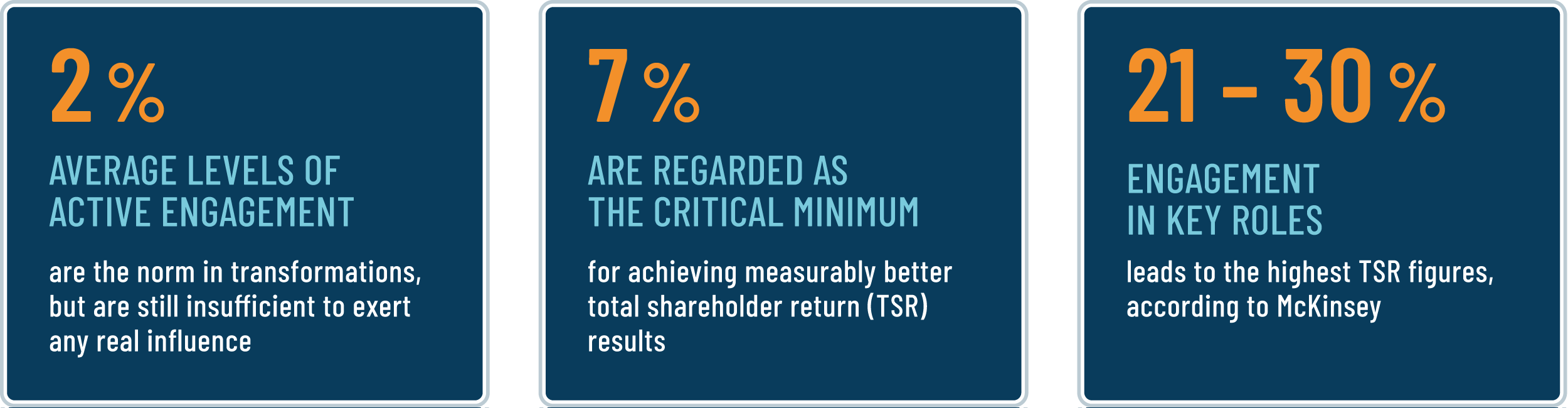
Source: McKinsey & Company (2021), ‘How many staff are actually needed during a transformation?’
Orchestrating transformation is not an abstract management concept. It is part of day-to-day leadership. It is reflected in the quality of decisions, the frequency of performance reviews and the rigour with which responsibilities and target achievement are monitored.
An effective management cycle begins at C-level with a simple question: Which of the current initiatives are still making a tangible contribution to which core strategic objective?
Only initiatives that can provide a clear and measurable answer to this question can justify the long-term commitment of capital and management capacity. This does not require an additional monitoring apparatus, but rather focused and honest performance dialogues. Genuine orchestration also requires a culture of consistent termination.
What is working and should be scaled up? Where are problems arising that require a direct decision from management? And which initiatives have lost their strategic relevance and should be discontinued so that resources can be freed up for new projects?
The key question for board members, managing directors and those responsible for transformation is therefore: ‘Are these initiatives having a measurable impact?’ rather than: ‘Do we have enough initiatives and flagship projects in our portfolio?’
Anyone who orchestrates impact today manages more than just a complex project portfolio. They shape the organisation’s operating system: with clear priorities, measurable targets, trust and consistency in implementation.
It is precisely in times of great uncertainty that this ability determines whether an organisation is merely keeping itself busy or actually making progress.
You are currently viewing a placeholder content from Hubspot Embedded Content. To access the actual content, click the button below. Please note that doing so will share data with third-party providers.
More InformationYou are currently viewing a placeholder content from HubSpot. To access the actual content, click the button below. Please note that doing so will share data with third-party providers.
More InformationYou are currently viewing a placeholder content from Hubspot Meetings. To access the actual content, click the button below. Please note that doing so will share data with third-party providers.
More Information